
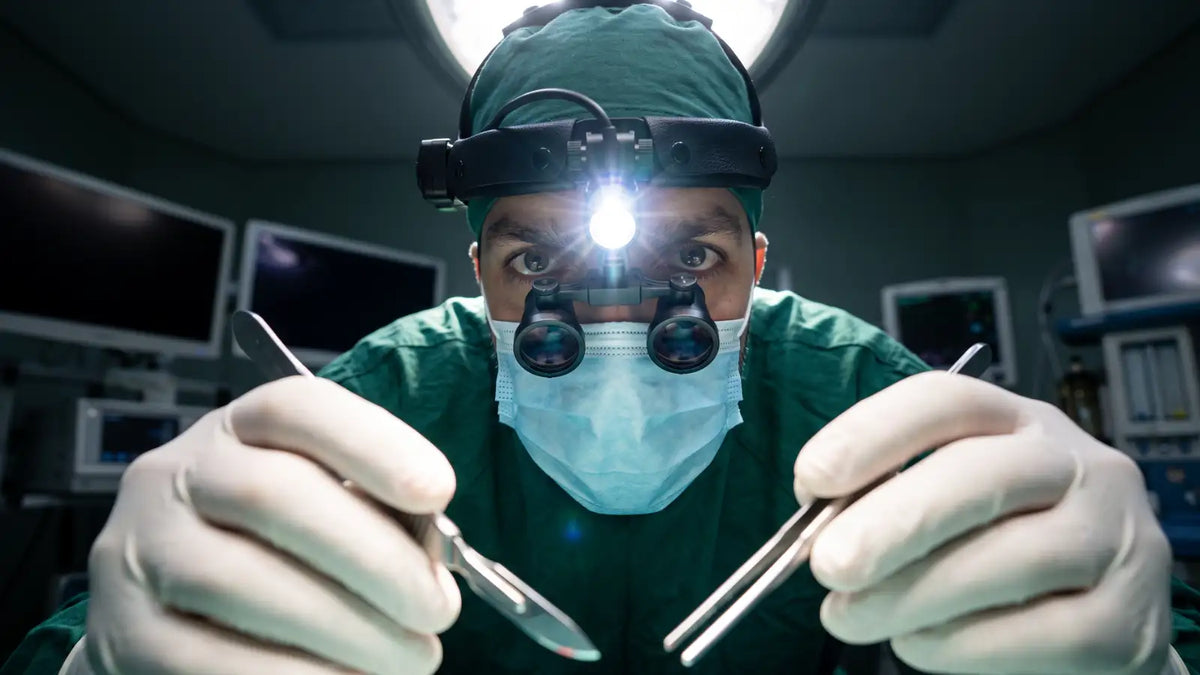
The camera angle in a surgical video is not merely a production decision. It determines which parts of the operation are visible, how the field is interpreted and whether the relationship between vision, instruments and movement can be followed.
Third-person surgical video and surgeon point-of-view video are not interchangeable. Each perspective can reveal important information, and each has limitations.
The educational question is not which format should replace the other. It is which perspective best supports the learning objective of a particular procedure.
What third-person surgical video shows well
Third-person video is usually recorded by a fixed camera or by an assistant positioned outside the operator's direct line of sight.
This perspective can be especially useful for understanding:
- patient positioning;
- operating-room setup;
- team roles and communication;
- surgeon and assistant ergonomics;
- external hand movements;
- equipment placement;
- the broader context of the procedure.
It is therefore an important educational resource, particularly when the learner needs to understand how the entire operative environment is organized.
Its main limitation is visual alignment. The external camera may be farther from the field, positioned at a different angle or temporarily blocked by hands, instruments or assistants. The image documents the operation, but it may not show the precise visual information guiding the operator at a critical moment.
What changes with surgeon POV
Surgeon POV uses a head-mounted or otherwise operator-aligned camera to record the procedure from a position close to the surgeon's line of sight.
When the surgeon turns toward an anatomical landmark, changes the direction of an instrument or modifies the angle of approach, the recording follows that visual orientation more closely than a fixed external camera.
This can help the learner study:
- the operative field from the operator's orientation;
- the relationship between both hands and the target anatomy;
- instrument entry angles and trajectories;
- how exposure changes during a maneuver;
- where attention is directed before the next action;
- how the sequence appears from the working position.
The educational proposition shifts from "watch the surgeon operate" toward "study the operation from a perspective closer to the one guiding the action."
POV is closer to the surgeon's view, but it is not identical to human vision
A POV camera should not be described as reproducing the surgeon's vision exactly.
Human vision includes binocular depth perception, selective attention, peripheral awareness and continuous eye movements that a single camera does not fully capture. A head-mounted camera follows head orientation, but it does not necessarily reveal the precise point of visual attention at every moment.
The most accurate positioning is therefore that POV provides a perspective closer to the operator's visual field. This distinction keeps the educational claim credible and avoids overstating what the technology can reproduce.
The best perspective depends on the type of procedure
Open surgery
In open procedures, the surgeon's line of sight may differ substantially from that of an observer standing beside the table. POV can be particularly valuable when the field is narrow, deep or easily obstructed.
Arthroscopy, laparoscopy and endoscopy
In monitor-based procedures, the direct video feed already represents the principal operative image viewed by the surgeon. In these cases, the monitor feed may be the most important educational perspective, while a POV or external camera adds context about hand positioning, instrument management and team setup.
Robotic surgery
Robotic procedures may require several synchronized views: the console image, an external view of the surgeon and team, and a view of patient-side instrumentation.
For many procedures, the strongest educational design is not a single camera. It is a deliberate combination of the views required to understand the clinical context, operative field and operator's actions.
Why visual alignment matters
Surgical performance involves a continuous relationship between perception and action.
The surgeon identifies a visual target, interprets its significance, selects an action, determines an instrument trajectory, executes the movement, observes the result and adjusts the next step.
A video becomes more educational when it helps the learner understand this sequence rather than presenting isolated movements.
POV can be useful because it preserves more of the spatial relationship between the operator's orientation, the hands, the instruments and the operative field. That does not guarantee learning by itself, but it can make important visual-motor information easier to study.
Why expert narration matters
An image can show what happened. Narration can explain the reasoning behind it.
During an operation, the surgeon makes decisions that may not be visible from movement alone:
- why one approach was selected instead of another;
- which anatomical landmark guides the next step;
- why traction is applied in a particular direction;
- when the operative plan should change;
- which structure is at risk;
- how the instrument angle should be adjusted;
- what common error should be avoided.
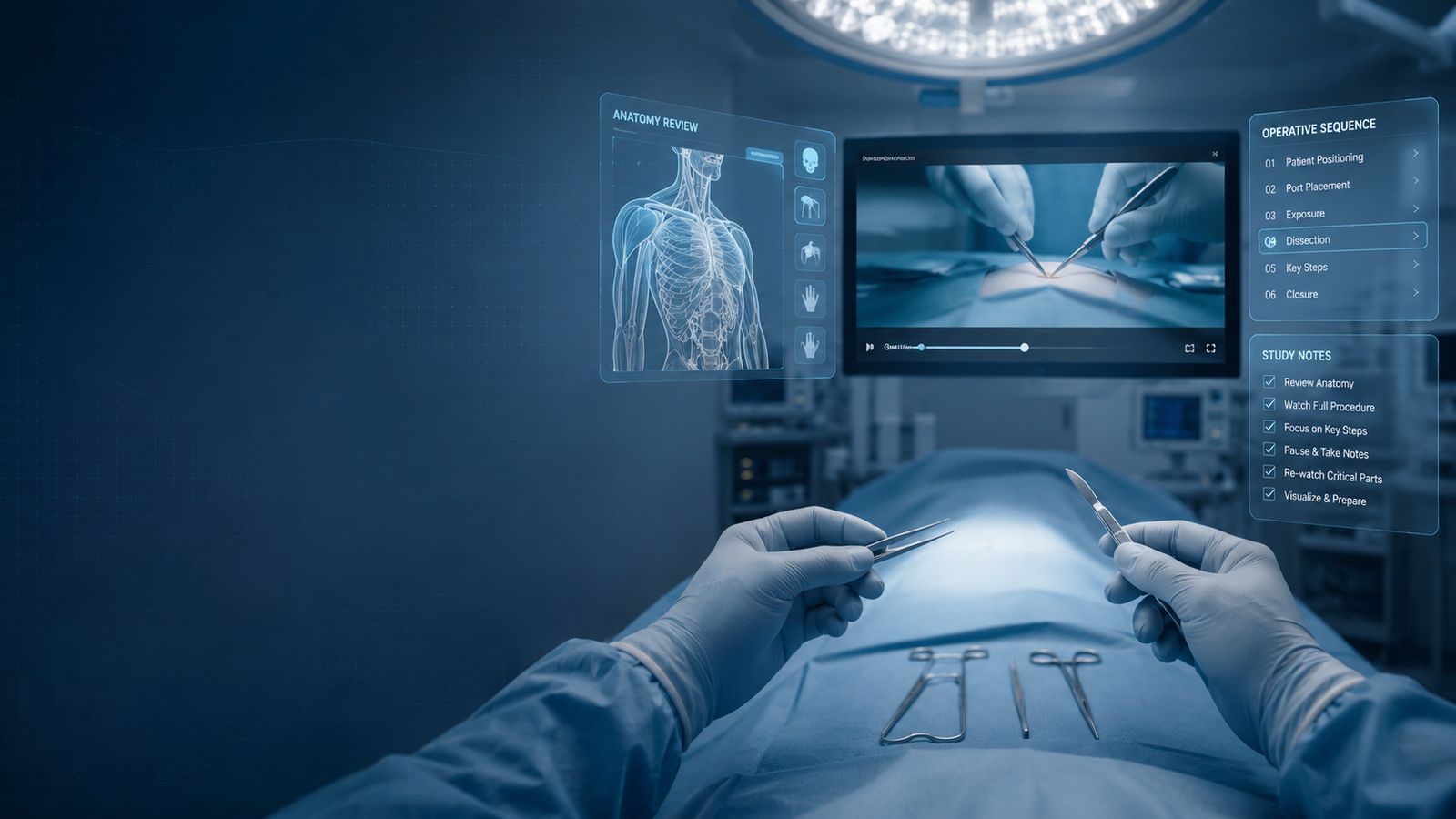
When first-person surgical visualization is combined with structured narration, the learner can study three connected layers: what the surgeon sees, what the surgeon does and why the surgeon makes each decision.
Repetition adds another educational advantage
A live operation cannot be paused or replayed. A recorded procedure can be revisited with a different objective during each viewing.
The first review may focus on overall flow. The second may focus on anatomy. A later review may focus on instrument direction, exposure, decision points or risk structures.
Repeated viewing is most useful when it is focused rather than passive. The goal is not simply to watch the same video again. The goal is to answer a different surgical question during each review.
For a structured workflow, see How to Study Surgical Videos Before Entering the Operating Room.
How to use third-person and POV video together
A practical sequence is:
- Use the external view to understand patient positioning, room setup, team roles and the overall procedure.
- Use surgeon POV to study the operator's orientation, instrument trajectories, exposure and critical maneuvers.
- Use the direct monitor feed when the procedure is endoscopic, arthroscopic, laparoscopic or robotic.
- Return to the external view to reconnect technical details with the broader operative context.
- Compare the perspectives and identify information that is visible in one view but absent from another.
This multi-perspective approach is often more educational than treating any single camera angle as universally superior.
The SNIPER Method
The Surgie educational model incorporates principles of the SNIPER Method, developed by Dr. Sávio Chami.
SNIPER stands for Surgical Narrative & Immersive Perspective with Enhanced Recording.
The methodology combines:
- first-person surgical visualization;
- structured technical narration;
- real operative procedures;
- pedagogical editing;
- anatomical and visual overlays when appropriate;
- repeatable access to the procedure;
- cognitive rehearsal and preparation for supervised practice.
The objective is not simply to create another collection of videos. It is to organize recorded procedures into educational experiences that can be observed, understood, repeated and reviewed.
Preparation, not substitution
Surgeon POV can provide a valuable educational perspective, but a video does not establish independent competence to perform a procedure.
Surgical learning still requires formal education, anatomical knowledge, professional judgment, qualified mentorship, simulation or cadaveric training when appropriate, supervised progression, institutional protocols, direct operative experience and credentialing.
Surgie and the SNIPER Method are designed to support that pathway by helping physicians prepare more deliberately for supervised clinical opportunities.
Watch a free procedure and explore surgeon-led surgical education on Surgie.
Educational notice: Surgie content is intended for qualified healthcare professionals. It does not replace professional judgment, formal training, credentialing, institutional protocols or appropriately supervised clinical experience.
Evidence and further reading
- Schmidt MW et al. Self-directed training with e-learning using the first-person perspective.
- Landry EC et al. The use of video glasses in surgical education.
- Beard HR et al. Using wearable video technology to build a point-of-view surgical education library.
- Youssef SC et al. Learning surgical skills through video-based education.

Leave a comment
This site is protected by hCaptcha and the hCaptcha Privacy Policy and Terms of Service apply.